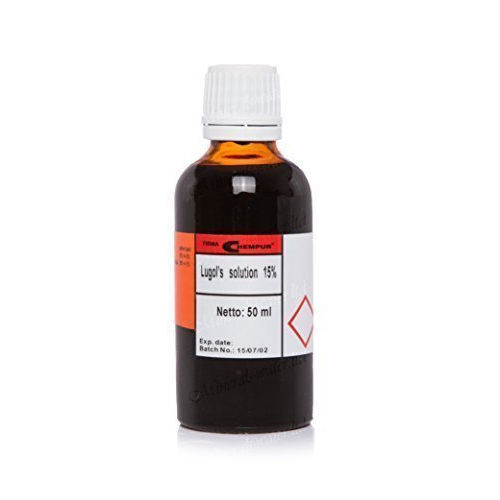
About Lugol s Iodine Solution
Lugols Iodine Solution is a Special chemical reagent highly regarded for its Flawless performance in laboratory and medical applications. With a concentration of 1%-2% iodine and 2%-4% potassium iodide, this praiseworthy dark brown liquid offers exceptional quality, meeting strict laboratory standards. Get reliable results in diagnostic staining or antiseptic use with this heroic solution, supplied in durable plastic or glass bottles. Stable under normal conditions, it boasts a shelf life of 1224 months. Handle with care, as it is an irritant and harmful if swallowed. Available in India through select dealers, exporters, manufacturers, producers, retailers, and suppliers.
Versatile Usage & Application Instructions
Lugols Iodine Solution serves as both a laboratory reagent and a key stain for Gram microscopy in medical diagnostics. Its Specific Use includes preparation as an antiseptic and for precise analytical processes. To apply, users should follow established protocols and laboratory directions for dilution or direct use. Ensure safe handling by wearing protective gear and following standard laboratory procedures. Its general use extends from research institutions to clinical laboratories, supporting both advanced and routine applications.
Sample Availability & Packaging Details
Samples of Lugols Iodine Solution can be requested to Evaluate the products reliability. The Estimate for supply ability ensures timely fulfillment of order sizes, supported by reliable Transport Servicesproducts are shipped swiftly within India and globally. Packaging details include strong, leak-proof plastic or glass bottles to maintain purity and stability throughout transit. Each lot is clearly marked for traceability and quality assurance. Experience seamless service and well-secured packaging with every shipment.
FAQs of Lugol s Iodine Solution:
Q: How should Lugols Iodine Solution be properly stored?
A: Lugols Iodine Solution should be stored tightly closed in a cool, dark place to maintain its stability and effectiveness throughout its shelf life of 12-24 months.
Q: What are the main applications of Lugols Iodine Solution?
A: The solution is primarily used as a laboratory reagent, a stain for microscopy (such as Gram staining), and as an antiseptic preparation in medical diagnostics.
Q: When is it necessary to take safety precautions while handling this product?
A: Protection is needed at all times during handling, as Lugols Iodine Solution is an irritant and can be harmful if swallowed. Always avoid contact with eyes and skin, and use appropriate laboratory personal protective equipment.
Q: Where can Lugols Iodine Solution be purchased in India?
A: It is available through select dealers, exporters, manufacturers, producers, retailers, and suppliers across India, ensuring easy access for laboratory and clinical usage.
Q: What is the process for proper disposal of Lugols Iodine Solution?
A: Dispose of Lugols Iodine Solution according to local regulations for chemical waste to prevent environmental or health hazards.
Q: How does the characteristic bitter taste and iodine odor affect its usage?
A: The characteristic bitter taste and iodine odor help confirm the identity of the solution but do not generally impact its efficacy in laboratory or medical applications.







 Send Inquiry


 Send Inquiry


